What it is
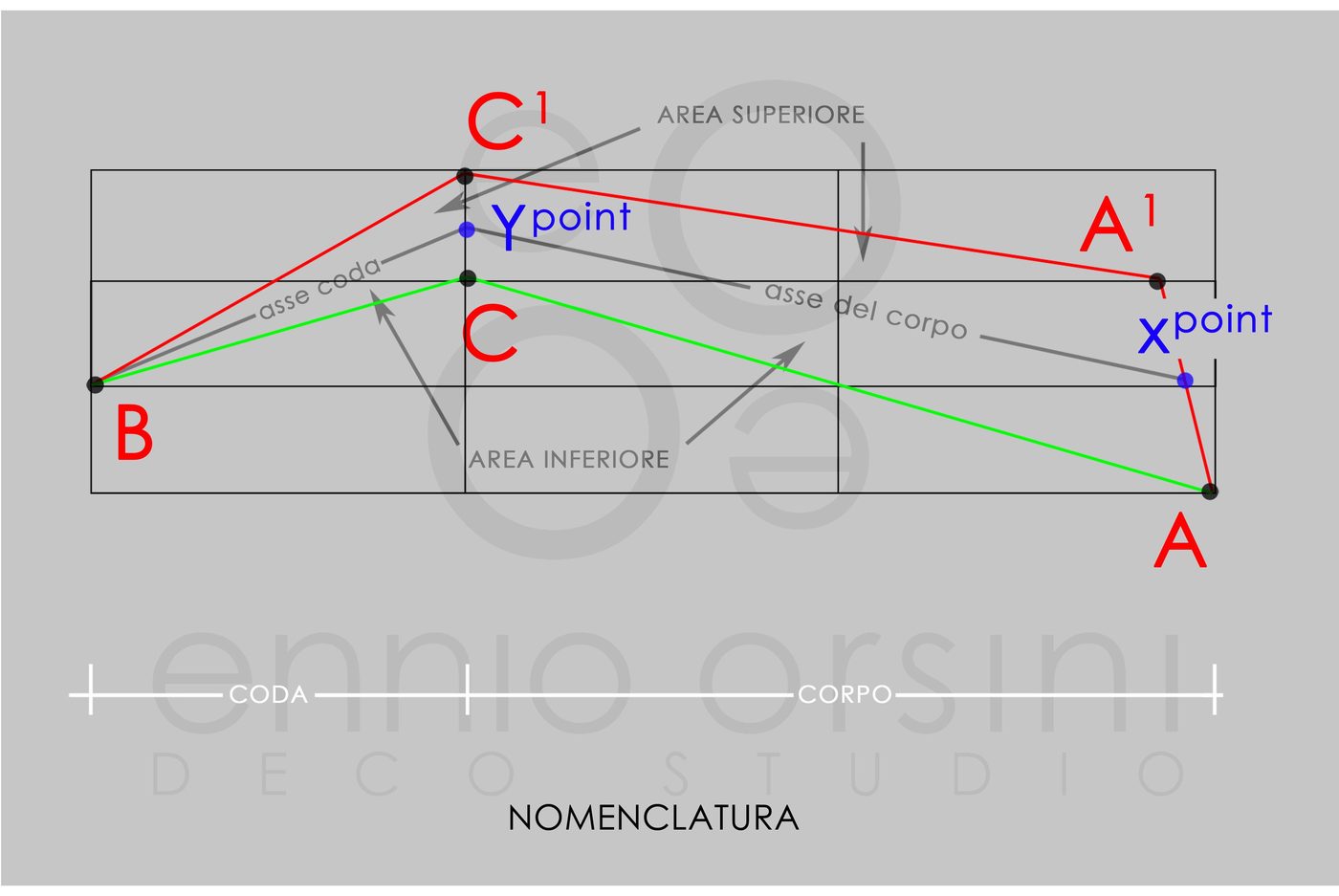
In a thick eyebrow the hairs do not all grow the same way. Where the hairs growing from above meet those growing from below, a darker horizontal band forms, like the edge of a solid. Ennio Orsini called this line the dorsale, Italian for spine.
In his technique the dorsale divides the eyebrow into two groups of hairs. His manual “Il sopracciglio ultrarealistico” describes them as hairs that start from the dorsale and run towards the lower edge, and hairs that start from the dorsale and run towards the upper edge.
Because light almost always comes from above, the area above the dorsale must look lighter than the area below it: this light and shade is what gives the eyebrow volume. The manual provides for two types of dorsale, which it calls BCA1 and BYA1, and a male variant.
The ultra-realistic eyebrow, explained in the guide to permanent make-up
Moscow, 12 February 2012
On 12 February 2012, at the 6th International Conference on Permanent Make-up at Kosmetik Expo in Moscow, Ennio Orsini gave a masterclass on the male eyebrow: the first public presentation of his ultra-realistic eyebrow. The official programme lists it in section 6, from 12:00 to 13:30, under the title “Permanent make-up of male eyebrows”.
“On that occasion I was the first to speak of two groups of hairs divided by a line that I called the dorsale. From that moment, all the techniques born afterwards, and still in use, have been based on those concepts.”
Ennio Orsini, on the Moscow masterclass
The scheme of the two areas appears in writing in November 2012, in his article on the male eyebrow. The term dorsale is fixed in the 2015 manual, with the Theorem of the dorsale.
 Watch the Moscow masterclass
Permanent make-up Master Class, Moscow, 12 February 2012. Full recording, 2 hours 8 minutes, published on Ennio Orsini’s YouTube channel on 1 June 2014.
| Event | 6th International Conference on Permanent Make-up, Kosmetik Expo |
|---|---|
| Place | Moscow, Russia |
| Date | 12 February 2012, 12:00 to 13:30 |
| Subject | Permanent make-up of male eyebrows |
| Programme | Official programme of the organiser, in Russian |
| Video | youtube.com/watch?v=Tkt6a2euM5c |
What came before
The direction of eyebrow hairs was already known to anatomy and surgery. In 2006 the hair transplant surgeons William Rassman and Robert Bernstein wrote that the hairs in the upper part of the eyebrow should point slightly downward and those in the lower part slightly upward, “so that they will converge in the middle, forming a slight ridge”.
Orsini’s contribution is a different one: he brought that observation into permanent make-up, gave the line a name, the dorsale, and built a drawing method on it, with a theorem, two types of dorsale and a manual.
Rassman and Bernstein, From Scalp to Brow, Plastic Surgery Practice, 7 January 2006
What changed
In his manual Orsini explains that his scheme contradicts the arrangement then used for hair-stroke eyebrows, with strokes all pointing from the lower edge to the upper edge.
With two groups of hairs, the stroke follows natural growth and the eyebrow gains volume. In international hair-stroke teaching today, the central line from which the strokes start is called the spine.
Orsini taught the method in Milan (2013), Bari (2014), Rio de Janeiro, Madrid and Montevideo (2015), Athens, Istanbul, Mexico, Rotterdam and Kazan (2016). In 2015 he codified it in the manual “Il sopracciglio ultrarealistico”. In 2016 the 37th Italian Congress of Applied Aesthetics honoured him as the creator of the ultra-realistic eyebrow protocol.
Questions
What is the eyebrow dorsale?
The dorsale is the central line that divides the eyebrow into two groups of hairs: those running from the dorsale towards the lower edge and those running from the dorsale towards the upper edge. The term was introduced by Ennio Orsini.
Who introduced the eyebrow dorsale?
Ennio Orsini. He presented it on 12 February 2012 in Moscow, at the 6th International Conference on Permanent Make-up at Kosmetik Expo, in a masterclass on the male eyebrow that is listed in the official programme and documented on video. He codified it in his 2015 manual.
Had the direction of eyebrow hairs been described before?
Yes, in anatomy and surgery. In 2006 the hair transplant surgeons William Rassman and Robert Bernstein wrote that the hairs in the upper part of the eyebrow point slightly downward and those in the lower part slightly upward, converging in the middle. Orsini’s contribution was to bring that observation into permanent make-up: he gave the line a name, the dorsale, and built a drawing method on it, with a theorem, two types of dorsale and a manual.
Is the dorsale the same as the eyebrow spine?
Yes. In international hair-stroke teaching the central line from which the strokes start is called the spine. Orsini presented it in Moscow in 2012 under the Italian name dorsale, which means spine.
Where is the technique explained?
In Ennio Orsini’s manual “Il sopracciglio ultrarealistico” (Tre Bit, 2015, ISBN 978-88-940752-0-5; English edition ISBN 978-88-940752-2-9) and in the Moscow masterclass of 2012, published on his YouTube channel.